After more than a decade of development and two high-profile delays, Grand Theft Auto VI has finally landed on consoles. Even before midnight launch queues formed, Take-Two Interactive and Rockstar Games had already generated over $1.5 billion in digital pre-orders alone (with total gross pre-launch revenue reaching an estimated $1.65 billion). For anyone who hasn't kept count, GTA has now spawned 62 titles across mainline entries, spin-offs, expansions, and remasters since the original top-down game appeared in 1997.
While most players will be focused on exploring the fictional state of Leonida, the legal and technical frame holding this release together is remarkable in its own right. In a global games market where the UK sector alone has reached £8.76 billion, GTA VI is a rare example of a single game that deploys virtually every available intellectual property right at once.
Behind the neon lights of Leonida sits a complex combination of trade marks, copyright, patents, and registered designs. Here is a look at the IP helping to protect one of entertainment's biggest franchises.
Building a Self-Contained Brand World
Big-budget blockbuster games, known in the industry as "AAA" titles, cost hundreds of millions of pounds to develop and market. At that level of financial risk, relying on a single form of legal protection is not enough. Instead, studios layer multiple IP rights so that each protects a different part of the game: trade marks guard the brand, copyright protects the creative assets, patents cover the underlying technology, and registered designs shield the visual appearance.
The trade mark history of Grand Theft Auto stretches back to the beginning of the franchise. DMA Design, the Scottish studio behind the original game, filed a UK trade mark application for GRAND THEFT AUTO on 16 March 1996, well before the game's release in 1997. The mark is now owned by Take-Two Interactive, who acquired the publishing and distribution rights in 1998 before acquiring DMA Design itself in 1999.
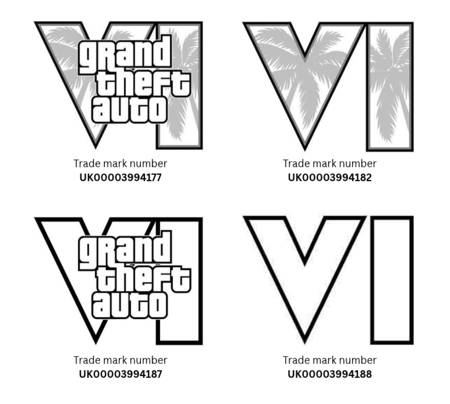 The brand has continued to develop since those early days. More recently, UK trade mark applications for GRAND THEFT AUTO VI were filed on 20 December 2023, including UK00003994177. The applications cover a range of goods and services, including software, digital content, clothing, and entertainment services.
This long-term approach to brand protection reflects how a successful video game can evolve beyond the game itself. Its name and identity can become valuable commercial assets, supporting future releases, merchandise, and other brand-related opportunities.
Fictional businesses and products are an important part of this world-building. Names such as eCola, Burger Shot, Eris and RydeMe help create a version of modern consumer culture that feels familiar to players, while remaining distinct from the real businesses they may recall. These invented brands contribute to the game's atmosphere and give its fictional locations a sense of commercial identity.
This context also gives rise to a particularly interesting business consideration in that developing a consistent identity for fictional products and services requires the same sort of creative thinking that goes into establishing a real-world brand. Names, logos, and visual identities help make those fictional businesses memorable, strengthening the overall identity of the game world. For developers, it is a reminder that branding can be an important part of the creative process, even when the businesses themselves exist only within a virtual environment.
Copyright, Radio Stations, and Likeness Disputes
Copyright underpins the entire game, covering the source code, models, dialogue scripts, artwork, and audiovisual sequences. Because copyright protects the specific expression of an idea rather than a broad gameplay concept, the breakout success of GTA III in 2001 inevitably inspired a wave of open-world crime competitors that could legally adopt similar sandbox mechanics without copying Rockstar's code.
Nowhere is copyright management more complex than in GTA VI’s radio stations. Curating a multi-decade soundtrack means clearing two separate rights for every single track: the musical composition rights in the lyrics and melody (held by songwriters and publishers) and the sound recording rights in the master track (held by record labels). Securing global synchronisation and interactive distribution licences for hundreds of songs is an enormous legal exercise. It is also why expiring licences have occasionally forced Rockstar to patch songs out of older titles years after release, a move that regularly sparks frustration among players who feel the music is inseparable from the game's identity.
Populating a realistic contemporary setting with satirical characters also invites scrutiny around personality and publicity rights. Rockstar has faced high-profile lawsuits over alleged unauthorised use of celebrity likenesses in the past, most notably from Lindsay Lohan and Karen Gravano following GTA V. In both cases, US courts dismissed the claims on the basis that the characters were generic satirical archetypes rather than identifiable depictions of the plaintiffs. Still, as generative AI and digital avatars blur the line between real performers and synthetic personas, voice and likeness rights remain one of the sharpest legal flashpoints in interactive entertainment.
The Engineering Patents Under the Hood
Because copyright cannot stop competitors from borrowing high-level gameplay ideas, patents are essential when it comes to protecting Rockstar's proprietary technology. Take-Two Interactive holds a thousand global IP assets, and browsing its patent portfolio on Google Patents shows just how much genuine engineering sits beneath the surface of an open-world game.
One of the hardest problems in an open world of this scale is making thousands of virtual citizens move and react convincingly without overwhelming console hardware. Take-Two's US11684855B2 addresses this through a hierarchical coarse graph navigation system that lets non-player characters plan routes and navigate crowded environments efficiently, paired with road network compression methods (US11071916B2) that streamline AI traffic pathfinding across vast maps.
Character movement presents a similar challenge. Standard pre-baked animations tend to look stiff the moment a character steps onto uneven ground or collides with an object. Pending application US20250095261A1 covers runtime animation retargeting, allowing character motion to adapt dynamically to changing terrain and physical interactions in real time. On the visual side, patents like US11978162B2 tackle continuous levels of detail, smoothly adjusting the geometric complexity of 3D models based on camera distance so massive vistas render without distracting visual "pop-in."
To protect years of research and development from leaks, reverse engineering, and automated AI scraping, Take-Two also relies on anti-tampering and software obfuscation patents such as US12050668B1. Combined with Rockstar's decision to launch exclusively on PlayStation 5 and Xbox Series X/S before bringing the game to PC later, pairing registered patent claims with strict platform security and digital rights management has become standard practice for safeguarding high-value codebases during their most lucrative launch window.
Modding, Designs, and the Selfridges Takeover
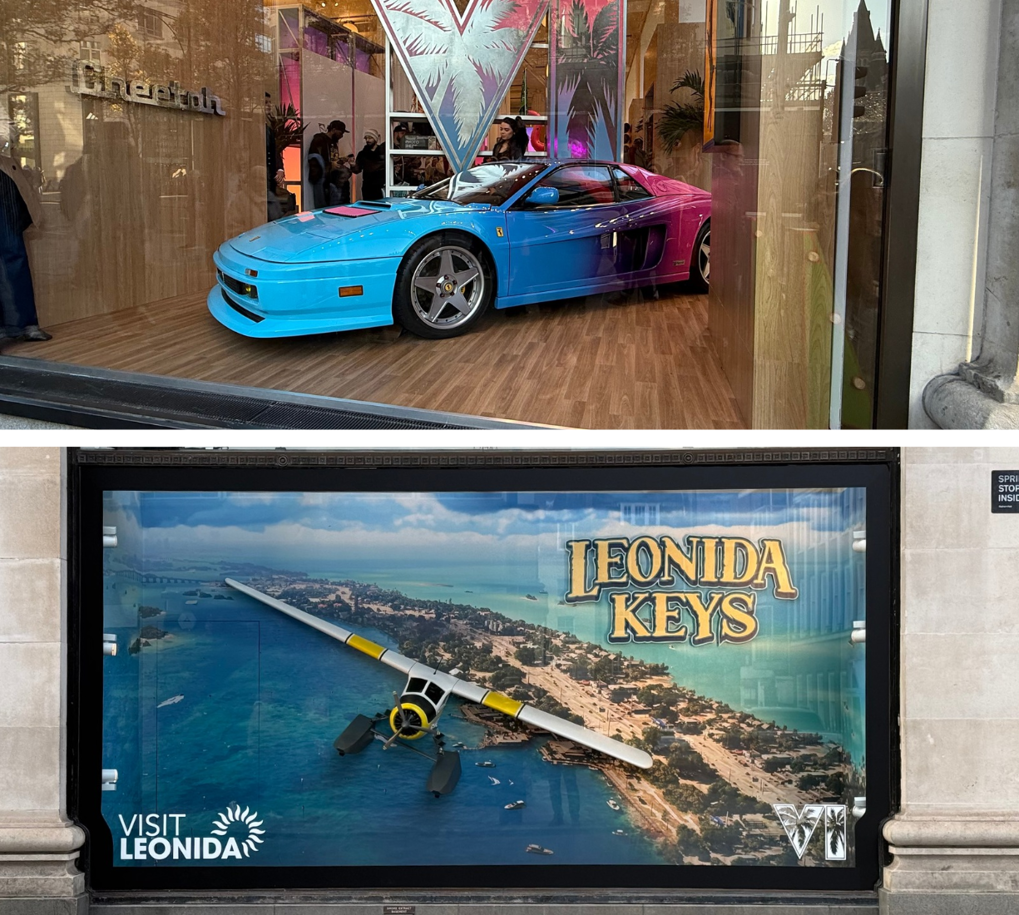
Photo credit: C Claxton
Running a massive online ecosystem also calls for careful judgment on enforcement. Take-Two routinely takes legal action against cheat software developers, account-boosting services, and commercial operators trying to profit from GTA Online without permission. At the same time, the publisher has learned to leave room for non-commercial, single-player fan modifications that keep older titles alive without threatening online security or third-party IP.
Visual aesthetics can also be protected directly through registered designs, which in the UK and EU offer a fast and inexpensive way to stop copycats from replicating distinctive user interfaces, vehicle silhouettes, weapons, and apparel.
To mark the launch in the UK, Rockstar partnered with London’s Selfridges to turn its Oxford Street Corner Shop into a neon-lit Vice City pop-up. The range spans everything from everyday Vice City souvenirs and a branded Winmau® Dartboard Set to Burger Shot kitchenware by Hedley & Bennett and a bespoke, £1 million road-legal Grotti Cheetah supercar built by West Coast Customs. Every item on display is commercialised off the back of registered fictional brands and protected in-game designs.
Looking Ahead
Watching Grand Theft Auto evolve from a scrappy 2D top-down experiment in 1997 into a billion-dollar cultural event nearly thirty years later is a reminder of how much the business of games has changed. Creative ambition still drives the franchise, but it is backed by decades of disciplined IP strategy including filing trade marks early, clearing complex global music rights, patenting core engine breakthroughs, and turning satirical world-building into protected commercial assets. For any studio building an ambitious interactive world today, GTA VI sets the benchmark for how to protect it.
*Use of logos and images in this article is for commentary and analysis only