


On the evening of 12 August 2026, people across the UK (and indeed many parts of Europe) will be able to witness a particularly deep partial solar eclipse. Around 90% of the Sun will be covered from London, increasing to roughly 95% in Cornwall, making it the most significant eclipse visible from the UK since the total solar eclipse of 1999.
Although the event will not reach totality in the UK, the same basic safety considerations apply. Looking directly at a partially eclipsed Sun without appropriate protection can cause permanent retinal damage, and the injury may occur without immediate pain. Ordinary sunglasses, even very dark ones, are not suitable for direct solar observation. Special-purpose solar filters are required.
Behind what may appear to be a relatively simple consumer product is a combination of optical engineering, materials science, manufacturing and product safety. It also provides an interesting example of where intellectual property can arise in the development of a technical product.
The technology behind safe solar observation
Solar-viewing filters have a demanding job. They must reduce the intensity of the Sun's radiation to safe levels while still providing a usable image of the solar disc. The relevant international standard, ISO 12312-2:2015, sets requirements for filters intended for direct observation of the Sun, including limits on transmission across ultraviolet, visible and infrared wavelengths, as well as requirements relating to uniformity, material quality, mounting and labelling.
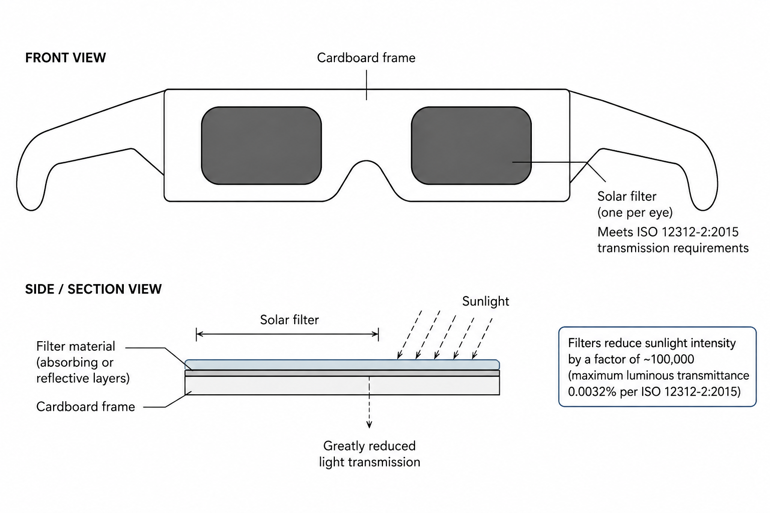
(Illustration of a solar-viewing filter and its role in reducing solar radiation to safe viewing levels.)
The standard specifies a maximum luminous transmittance of 0.0032%. It also imposes requirements on the physical quality of the filter. For example, metal-coated filter materials are subject to limits on defects such as pinholes, reflecting the potential safety implications of even small areas of excessive transmission.
Different technologies can be used to achieve the necessary filtering performance, including metal-coated polymer films and light-absorbing filter materials. The choice of material, coating, substrate and manufacturing process can affect not only the optical performance of a filter but also its durability and appearance.
Those engineering challenges can create opportunities for patent protection. A novel filter material, optical structure or manufacturing process may be capable of protection where it meets the relevant requirements for patentability. Equally, an invention may lie in how a filter is mounted or integrated into a wider product rather than in the filter material itself.
Solar viewing and smartphone technology
The development of solar-viewing products has also extended into consumer electronics.
With millions attempting to record the eclipse on mobile devices, pointing unfiltered smartphone cameras directly at the Sun can permanently damage or burn the devices internal image sensor. However, holding paper eclipse glasses over a smartphone lens rarely provides a secure or effective seal. This has prompted the development of solar filters for mobile devices, while filters for optical lenses and telescopes must be carefully engineered and securely attached to protect both the user's eyes and the delicate hardware.
There are a number of patents and patent applications within this specific technical field. For example, US Patent No. US11438494B1, entitled "Device for viewing and imaging the sun and solar phenomena", was granted to Graphic Arts Systems, Inc. in 2022. The patent illustrates how an invention in this field can extend beyond the filter itself to the way solar observation and imaging are combined within a device.
This is a useful reminder that, when assessing a new product for patent protection, it is worth looking beyond the obvious technical component. The inventive concept may instead be found in the interaction between components, the way a product is manufactured or the way it solves a particular problem for the end user.
Standards, regulation and IP
Technical innovation is only one part of bringing a solar-viewing product to market. Manufacturers must also consider the regulatory requirements applicable to the product and the market in which it will be sold.
ISO 12312-2 is a technical standard rather than a product certification scheme. ISO does not test or certify individual solar viewers. Products should therefore not simply be described as "ISO certified" or "ISO approved". Conformity with the standard is established through appropriate testing and assessment.
In Great Britain, solar-viewing eyewear that falls within the scope of the personal protective equipment regime must meet the applicable essential health and safety requirements and undergo the relevant conformity assessment process. Current Government guidance allows qualifying PPE placed on the GB market to use either CE or UKCA marking, subject to the applicable requirements.
This illustrates an important distinction for businesses developing technical products. IP protection and regulatory compliance address different aspects of commercialisation. A patent may protect an invention, but it does not establish that a product is safe or compliant. Conversely, satisfying a technical standard does not prevent another business from developing a competing product or, where applicable, obtaining IP protection for its own innovation.
Protecting innovation beyond the core invention
The eclipse provides a useful example of how IP considerations can arise throughout the development of a technical product.
The underlying invention might be a new optical filter or material. It might instead concern the manufacturing process, the arrangement of optical components or the integration of a filter into a device. Other aspects of the finished product, such as its appearance or brand identity, may raise separate design or trade mark considerations.
Identifying these different elements at an early stage can be important. A business that concentrates solely on the headline invention may overlook other commercially valuable aspects of its product.
For innovators in optics, imaging, engineering and consumer technology, the lesson extends well beyond solar-viewing products. Intellectual property should be considered as part of product development, rather than only once a product is ready for market. For advice on protecting optical technologies, product designs, trade marks or other innovations, contact the team at Secerna.
Safety Notice: Never look directly at the solar eclipse without appropriate solar-viewing eyewear meeting ISO 12312-2:2015.